

NSTA Standards
Earth is the third planet from the sun. The Solar System has a sun, moons and eight planets. Our earth has one moon. Other planets have none or more than one. Smaller objects such as asteroids and comets are in our solar system. The Milky Way is the name of our galaxy and it contains billions of stars. Gravity and energy affect our solar system.
Key Concepts
Our solar system has a sun, planet earth and a moon. These three objects are all quite different from each other. The sun is a ball of fire; the moon is a cold rock. Only planet Earth has land, air and water, which make life possible.
Teaching Ideas and Tips
NOTE: This lesson should take at least a week.
Suggested Printables clip art:
Grey planet
Smiling Earth
Yellow Sun
Display three large pieces of chart paper or divide your white board into three sections. Label the sections with the words Sun, Moon, and Earth. Draw on students’ prior knowledge by asking them to tell you facts that they already know about each of these objects. Sample answers: “We see the sun in the daytime.” “We see the moon at night.” “We live on planet Earth.” “The sun is fire.” “The moon is far away.”
They may also give you incorrect information such as, “There is a man in the moon.” “The moon is made of cheese.” “The moon is larger than the sun.” Be sure to record all statements, even those that are not true. When you have finished making the charts, explain that some of the information on there is true and that some is not. Help the children to understand that the lesson for the next few days will be to find out what is correct and what is not correct. They will also be comparing the characteristics of the sun, the moon, and planet Earth.
Divide students into three groups (try to get a paraprofessional or parent volunteer to assist you) and give each group a topic - the sun, the earth, or the moon. Help students look through books or internet pages (see instant Internet Activities section in the Home Extensions tab) to see if they can prove or disprove any of the information on the chart. As they verify the information, have them circle the statements on the chart. If they find that some statements are incorrect, have them cross these off. At the end of the activity, have each group stand and tell the rest of the class what they learned is true. Allow them to share posters or books to prove what they have learned. (Example: Seymour Simon’s book, The Sun, clearly shows it as a ball of fire. His book, Our Solar System, clearly shows the moon as a rock.) Clearly, planet Earth is neither a ball of fire nor a cold, lifeless rock. Ask what planet Earth has on it (land, water, plants and animals).
Help your students compare the three objects – the sun, the moon, and planet Earth. They should see how they are the same (all part of the solar system, all have a spherical or ball shape) and how they are different. Now add the suggested clip art to the tops of the charts.
When you are talking about the sun and the moon, be sure to use the correct word, sphere, to describe them. Show spherical objects to clarify what a sphere is and how it is different from a circle.
In Pre-K and Kindergarten, introduce the most basic size comparisons by showing three different sizes of balls to represent the sun, the earth and the moon. Use the words big, bigger, biggest or small, smaller, and smallest.
Classroom Management
For the youngest students, do this as a three-day activity – one day each to gather facts about the sun, the moon and Earth. Provide books, posters and internet activities that have good photographs so that students can make most of their observations from visual clues.
If you do not have assistants in your classroom, make the verification of the chart information into a whole group activity on each of three separate days. Remember to keep this language simple and the sentences short. Because your students probably cannot read, or have limited reading vocabularies, they will need to rely on visual clues. Make sure you provide research materials that are age appropriate and that contain actual photographs – not “cutsie” drawings. You can use the cute illustrations for art projects, but they should not be used for research purposes.
Use the student drawings that your students will create from the suggested activity in the assessment tab to decorate a bulletin board about the solar system. These can also be shared with parents in conferences.
Vocabulary
Sun – Our sun is a ball of fire. We see it in the daytime.
Earth – We call our home planet Earth. Earth has land, water, plants and animals.
Moon – We have only one moon. It is a cold, lifeless rock. We see it at night.
Compare – To compare is to see how two or more things are the same and how they are different.
Same – We say that things are the same if some parts of them are alike.
Different – We say that things are different if they are not alike.
Use this Solar System Vocabulary list as a start—add more of your own—and use Make Your Own tools to create your own flash cards!
Solar System: Lesson 2 Flash CardsPrintables Resources
Bulletin Boards
Solar System Graphics
Fine Motor Skills, Alphabet Practice and Beginning Reading Skills
Alphabet - Writing the Alphabet
Fine Motor Skills Tracing Curved Lines
Astronaut - Coloring Page
My Space Book - Coloring Page
Our Solar System – Coloring Page
Rocket Ship and Boy Astronaut - Coloring Page
Beginning Math Skills
Out of This World – Count and Write the Correct Numeral
Out of This World – Alphabet Sequencing (Dot-to-dot)
Lesson Plans and Smart Board Activities
Note: to use a resource with your interactive whiteboard, click on the "VIEW FULL SCREEN for use with interactive white boards" button below the preview window.
Traditional Manuscript Printing – Trace and write the names of planets
Out of This World – Alphabet Sequencing (Dot-to-dot)
Stationery for Send Home Letters or Student Illustrations
Outer Space Reproducible Border
Clip Art
Moon and Star
Grey planet
Love Our Planet Smiling Earth
Yellow Sun
Outer Space
Out of This World Award
Art or Homework Project
Spaceship – Shuttle pattern and lesson plan
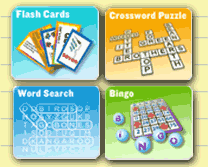
Flash Cards and Learning Games
Flash Cards
Crossword Puzzle
Word Search
Bingo
Assessment
Use Printables Outer Space - Unlined Stationery.
Have students write their names on their papers. On the chalkboard or white board, write the word, “sun” and ask students to copy it on their papers. Then have them draw a picture of the sun. Now write the word “moon” and have them copy your printing. Have them draw a picture of the moon. Finally, write the word “Earth” and have them copy your word. Have them draw a picture of planet earth. Instruct children to color the three circles.
Assess your students’ understanding of the lesson by noting if they make the sun larger than Earth and the moon smaller than Earth. The sun should be colored yellow, the moon should be a shade of gray, and the earth should be green and/or blue. You can get an additional grade by assessing their printing skills. (NOTE: If your students are beginning writers, write the words one letter at a time.)
Send Home Letter
Here are two parent letters. You may choose to print the first letter and have students fill in the blanks or you can choose the second letter that is completed for the children. Remember that you can easily add or delete sentences or information before printing these to go home.
Try printing this send home letter on Outer Space Stationery!
Fill In The Blanks version
Completed version
Or you can also print these letters on your own - copy/paste the letter below into a Microsoft Word document. You can add or remove text and customize the letter to your liking.
Dear Family,
We learned about the _________. I can write these new words; _______, ______, and _________. Our new word for the week is ________.
We also learned ________________________________________________________________________.
___________
(child’s name)
Dear Family,
We learned about the solar system. I can write these words: sun, moon and earth. SEE!
__________________, _____________________, ______________
Our new word for the week is “sphere.” A sphere is a ball shape. Here is a picture of a sphere:
We also learned that we get heat and light from the sun.
____________
(child’s name)
Homework
- Help students practice their printing skills by having them copy the names of all of the planets.
Traditional manuscript Trace and Write – Names of Planets - Have students practice connecting letters in alphabetical order.
Out of This World - Alphabet Sequencing (Practice Page) (Dot-to-dot) - Have students practice addition facts to 18.
Eighteen Stars: Math Practice Page
More to Explore
Instant Internet Activities:
Picture Dictionary
This picture dictionary contains actual photographs and easy to read definitions.
Coloring Book for Pre K-K-1
12:18 PM 9/16/2010
A fun little online astronomy coloring book.
NASA Coloring Book
Enjoy coloring without the mess! Have fun with The Space Place Coloring Book!
Send this letter home to parents who may request additional science activities that are appropriate for their children.
Try printing this letter on Printables Outer Space unlined stationery! Or you can also print this letter on your own - copy/paste the letter below into a Microsoft Word document. You can add or remove text and customize the letter to your liking.
Dear Parents,
Our class has been learning about the sun, the moon and planet Earth. We have been learning how these three objects are the same and how they are different. You can help your child better understand these comparisons if you help them compare items in your home.
Select two items that have some characteristics in common, but are still very different. For example, go in the living room and ask your child to point to the sofa and then to a chair. How are these two items the same? How are they different? (If your child has trouble verbalizing this, you go first. “They are different because sofa is blue and the chair is green.” “They are the same because we can sit on both of them.”)
Occasionally repeat this exercise so your child can continue to make comparisons of common objects.
Your child’s teacher,
__________
Follow-Up Activities:
Got some parents that are eager to provide their children with extended activities to go with the solar system? Provide them with this list! Of course some of these suggestions, such as actually visiting a NASA center may be impossible, but most of these ideas can easily be completed by visiting a library or by searching the internet.
Try printing this list on Space Stationary! Or you can also print this list on your own - copy/paste the list below into a Microsoft Word document. You can add or remove text and customize the list to your liking.
- Visit a science center planetarium to view the deep space exhibit.
- Visit the space center to see the launch pads – even attend space camp – ride the simulated space shuttle launch.
- Build a model of the shuttle.
- Learn about the suits the astronauts are wearing while they repair the telescope.
- Find out about future planed space missions – to the moon, to Mars. What are the problems with space travel?
- Go on line to read about the discoveries of the Hubble telescope over the last 19 years.
- Read about the history of the telescope.
- Learn the parts of a telescope and how Hubble is different from a telescope.
- Read about deep space and view the galaxies that Hubble has discovered
- Find out – Who was Hubble???
- Create art projects that show the most beautiful galaxies
- Have a Perseid meteor shower sleepover! Make it an “out of this world” party and stay up late enough to see the meteors. Have glow in the dark decorations and a craft activity.
Teaching Units are for subscribers only. Please login to access the site.
Not a subscriber? Subscribe Now for access to Scholastic Printables Teaching Units