

NSTA Standards
Earth is the third planet from the sun. The Solar System has a sun, moons and eight planets. Our earth has one moon. Other planets have none or more than one. Smaller objects such as asteroids and comets are in our solar system. The Milky Way is the name of our galaxy and it contains billions of stars. Gravity and energy affect our solar system.
Key Concepts
The sun brings light and heat to Earth. Light from the sun helps keep earth’s surface warm, gives us light, and allows plants to grow.
Teaching Ideas and Tips
On chart paper or the white board, write the question: How does the sun affect the earth? Students may respond with comments about night and day or about the seasons. Tell the children that you are going to do an “experiment” today that will help them learn about one way the sun affects the earth. Ask if anyone knows what an “experiment” is and explain that it is a test to see if what we know is really true.
Help students measure equal amounts of water into two flat dishes of water and take them outside. Place one in the shade and the other in the direct sun. Ask students to speculate about how the sun will affect the water.
After about two hours, take the children back outside and let them feel the differences in the water temperatures. Ask students to give their theories about why this is true. Explain that our earth is warm because of the light and heat from the sun.
When you return to the classroom, write the results of your experiment on your chart paper. You may choose to draw the two dishes of water with one in the shade and one in the sun.
Ask students to try to think of why this might be important to planet Earth. What would happen if the sky was always filled with clouds that made the earth in the shadows? What would be affected on earth? (Plants would not grow as well; the swimming pools would be colder; students would have to wear heavier sweaters and coats.) Guide students to conclude that the sun’s heat and light affect out earth in just exactly the right way that enables us to live here on earth.
Classroom Management
- Remind students to NEVER look directly at the sun as it can damage their eyes.
- If your students are mature enough, allow them to use “science kit” thermometers to measure the amount of heat in the water.
- Ask students to give other examples of how they may already know that we get heat from the sun. Examples might include: We play in the sun on a cold day so that we stay warm. The sun can melt a snowman. We like to play in the shade of a tree in the summer.
Vocabulary
Sun – Our sun is a star at the center of our solar system. We see it in the daytime.
Earth – We call our home planet Earth.
Star - A star is a big ball of fire.
Heat – Heat is the amount of “hotness” or temperature of an object.
Use this Solar System Vocabulary list as a start—add more of your own—and use Make Your Own tools to create your own flash cards!
Solar System: Lesson 1 Flash CardsPrintables Resources
Bulletin Boards
Check Out This Space
Our Solar System
Fine Motor Skills, Alphabet Practice and Beginning Reading Skills
Letter R: Letter Formation Practice
Alphabet Skills
The “un” Wheel
Rhymes With
Beginning Math Skills
Adding Things Up
Subtraction from 12 or Less
Lesson Plans and Smart Board Activities
Note: to use a resource with your interactive whiteboard, click on the "VIEW FULL SCREEN for use with interactive white boards" button below the preview window.
How is the Weather? - color version for Interactive White Board
How is the Weather? – black and white reproducible
Stationery for Send Home Letters or Student Illustrations
Space: Stationery (With or Without Lines)
Clip Art
Solar System Graphics
Rocket Ship
Outer Space
Out Of This World Award
Outer Space
Four smiling stars
Art or Homework Project
Solar System Mobile links
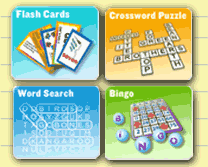
Flash Cards and Learning Games
Flash Cards
Crossword Puzzle
Word Search
Bingo
Assessment
Print out How is the Weather? For a color version, click here.
Have students draw lines to match the appropriate clothing to the kind of weather illustrated. If the sun is behind the clouds, it is colder, so we need to wear warmer clothing.
For an informal assessment project, take your students to the playground on a particularly hot day. Arrange two games such as tag or “Duck, Duck Goose.” Play one game in the shade and one game in the bright sunlight. Ask students how the two games were different. Sample responses might include: “We could play longer in the shade.” “We were sweating in the sun.” Ask them to remember the experiment about the water and remind them that the sun will heat them the same way as it heats the earth and the water in the dishes.
Send Home Letter
Print this send home letter on Space Stationary! Or you can print the letter on your own - copy/paste the letter below into a Microsoft Word document. You can add or remove text and customize the letter to your liking.
Dear Parents,
Today your child helped conduct an experiment to show how the sun affects the earth. We put bowls of water outside – one in the sunshine and one in the shade – and waited two hours. When we checked the water, we noticed that something had changed! Ask your child how the two dishes of water were different after they had been outside for a while. Try to use these words: experiment, temperature, sun, affect, compare, and shade.
You may want to repeat this experiment at home. (Best done on a cold or cool night!) Try this variation: Help your child put water into a shallow dish, feel the temperature of the water, and put it outside for the night. The next morning, check the temperature of the water again. You and your child should be able to feel a difference, but you could also use a thermometer to show and record the differences in temperature. Ask students why the water outside over night was cooler and guide them to conclude that there was no sun to keep it warm.
Your child’s teacher,
__________________
Homework
Connect your science and math lessons by printing out copies of the following printables and send them home for homework.
Adding Things Up
Subtraction: From 12 or Less
Connect to reading by printing and copying this page on which students will be matching words that rhyme with “sun.”
More to Explore
Instant Internet Activities:
Memory Game
Match solar system pictures in this fun memory game.
Shape Match
Drag and drop matching shapes in this fun solar system themes game.
Learning About the Sun: The Pre-K and Kindergarten Experience
Here you will find sun and fun activities to do with kindergarten students. This site includes lesson plans and actual photographs of students doing the suggested activities.
Follow-Up Activities:
For parents who may want to do additional activities at home, print copies of this letter to send home.
Send Home Letter - Follow Up ActivityOr you can print the letter on your own - copy/paste the letter below into a Microsoft Word document. You can add or remove text and customize the letter to your liking.
Dear Parents,
Our class has been learning that the sun has an effect on planet earth. We get both heat and light from the sun. Help your child to understand this concept by conducting this quick experiment on the next sunny day.
First – have your child remove his or her shoes. (This is more fun if you take off your shoes and do the experiment too!)
Second – take your child outside and ask them what part of the sidewalk they think will be the hottest – the part in the sun or the part in the shade.
Third – have your child stand with bare feet on different part of the sidewalk. Can they feel the difference? Ask them why part of the sidewalk is hot and part is cold.
Fourth – If possible, take your child back outside in the evening. Ask your barefoot child to feel the coolness of the sidewalk then. Why is it cooler in the nighttime than in the daytime?
End the conversation by helping your child realize that the sun gives heat to the earth. Parts of the earth that are in the shade still get some heat, but not nearly as much, so they feel cooler.
Your child’s teacher,
______________
Got some parents that are eager to provide their children with extended activities to go with the solar system? Provide them with this list!
Suggested Solar System Follow Up Activities!
Of course some of these suggestions, such as actually visiting a NASA center may be impossible, but most of these ideas can easily be completed by visiting a library or by searching the internet.Try printing this list on Space Stationary! Or you can also print this list on your own - copy/paste the list below into a Microsoft Word document. You can add or remove text and customize the list to your liking.
- Visit a science center planetarium to view the deep space exhibit.
- Visit the space center to see the launch pads – even attend space camp – ride the simulated space shuttle launch.
- Build a model of the shuttle.
- Learn about the suits the astronauts are wearing while they repair the telescope.
- Find out about future planed space missions – to the moon, to Mars. What are the problems with space travel?
- Go on line to read about the discoveries of the Hubble telescope over the last 19 years.
- Read about the history of the telescope.
- Learn the parts of a telescope and how Hubble is different from a telescope.
- Read about deep space and view the galaxies that Hubble has discovered
- Find out – Who was Hubble???
- Create art projects that show the most beautiful galaxies
- Have a Perseid meteor shower sleepover! Make it an “out of this world” party and stay up late enough to see the meteors. Have glow in the dark decorations and a craft activity.
Teaching Units are for subscribers only. Please login to access the site.
Not a subscriber? Subscribe Now for access to Scholastic Printables Teaching Units