

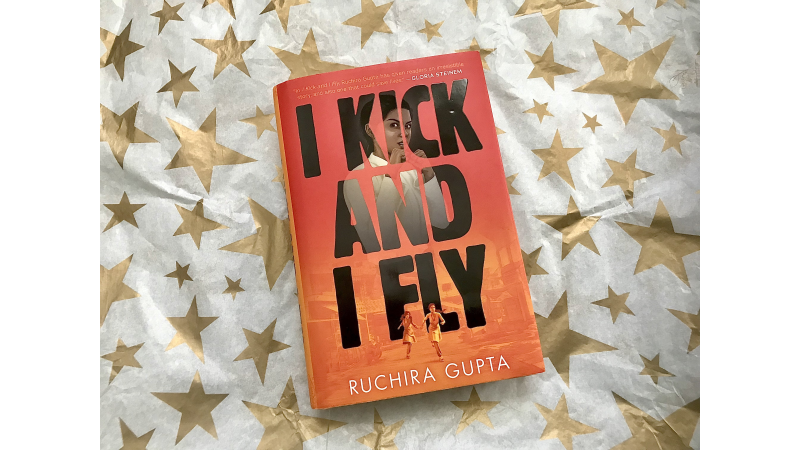
During Women’s History Month, we celebrate the triumphs of leaders of the past. But for our latest Scholastic Reads podcast episode, I spoke with Ruchira Gupta about ensuring a brighter future for marginalized girls around the world. A journalist, author, and activist, Ruchira is the co-founder of Apne Aap, a non-governmental organization (NGO) that helps girls and women in India, Nepal, and elsewhere escape the brutal world of sex trafficking and prostitution.
Ruchira’s work with vulnerable girls and women inspired I Kick and I Fly, her new novel for young adults. The story introduces readers to 14-year-old Heera, who is growing up on the outskirts of a red-light district in India. Heera escapes being sold into the sex trade when a local activist teaches her kung fu and helps her understand the value of her body. As Gloria Steinem says, I Kick and I Fly is a book “that could save lives.”
Ruchira is also a visiting professor at New York University. Her documentary about sex trafficking in India and Nepal, The Selling of Innocents, won an Emmy Award in 1996 for outstanding investigative journalism. She holds a Doctor of Humane Letters from Smith College.
Here are highlights from our conversation, which has been lightly edited for length and clarity.
Tell us about your debut YA novel.
I Kick and I Fly is about a young girl named Heera who is only 14 years old. She’s born into a nomadic tribe in India and about to be sold into prostitution. A woman’s right advocate enrolls her in a kung fu program. Through the practice of kung fu, Heera discovers the power of her body and fights for it.
Can you describe the world that Heera is growing up in?
Heera means diamond in Hindi, and Heera is like a diamond in the dust. She’s growing up on a dirt street with mud huts on both sides. There’s no concrete infrastructure. There’s no running water or toilets. Most of the mud huts have no doors, windows, or electricity.
Many of the mud huts have a back room used for prostitution. They call the lane Girls Bazaar to themselves jokingly, because this is where girls are sold. The only shops on the street are a liquor store selling country liquor, a gambling joint, a little betel leaf store, which sells things like tobacco, and a pawn shop.
Behind the street is a big stretch of empty ground where the annual cattle fair comes. And on the other side of the street are the railway tracks.
The setting is inspired by a community in India, right?
Yes, it’s a small agricultural town on the border of India and Nepal. It’s very fertile, very green, with rice fields, wheat fields, and jute growing there, and birds and animals all around.
There are not many big markets nearby, so the farmers get together every year to exchange seeds, and sell and buy fertilizer and produce. That’s how the cattle fair began, where they would sell their cattle and produce.
Slowly, over the years, the cattle fair became a place where farmers with ready cash would come and buy girls. Many of the stalls inside the cattle fair became striptease bars. They were called orchestra parties, and girls were sold on stage with little number tags on them as they danced. Inside this tented city, which was the cattle fair, there would be little rooms with just a flap in front where girls were taken by customers who bought them.
