Primary Sources: America's Teachers on America's Schools. A project of Scholastic and the Bill & Melinda Gates.

PRIMARY SOURCES:
AMERICA'S TEACHERS ON AMERICA'S SCHOOLS

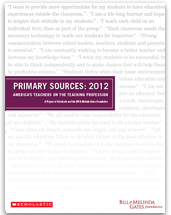
Scholastic and the Bill & Melinda Gates Foundation asked 40,000 of our nation's public school teachers for their thoughts on American Education with the goal of placing teachers’ voices at the center of the discourse around education reform.

Contact / Media

Kyle Good
Scholastic
212-343-4563

Media Relations
Bill & Melinda Gates Foundation
206-709-3400

Presented By:

Bill & Melinda Gates

Scholastic

Share |

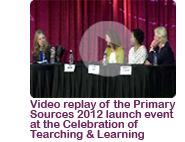
Video Replay

Presenters:

Vicki Phillips

Vicki Phillips

Director of Education,
College Ready
Bill & Melinda Gates Foundation
Margery Mayer

Margery Mayer

President,
Scholastic Education
Scholastic Inc.
Harry Smith

Harry Smith

Co-Anchor,
The Early Show
CBS News

Featured Teachers:

Beth Prince

Beth Prince

Kindergarten Teacher,
Hearst Elementary School,
Washington, D.C.
Andy Liss

Andrew Liss

7th Grade Teacher,
Thomas Jefferson Middle School,
Edison, N.J.
Cate Dossetti

Cate Dossetti

9-12th Grade Teacher,
Fresno High School,
Fresno, CA

Comments

Comments are moderated. Please do not post off topic.

* First name, email, comment are required.
Your email will not be shared.

Most Recent Comments

  • #105 Yvonne
    3/15/2010 12:49:06 PM

    I have been teaching for 25 plus years. It appears in Washington, D.C. we as teachers do not do anything right. It has been a hositile environments sense chancellor Reed has gotten into office. I know and am a great teacher. I to know my subject matter very very very well. I am committed to students and their learning, I can and I do monitor my students learning in the class and out of the classroom. I don't know what else this woman wants. Oh yes I do think about and learn from all my 25 plus years of experience. In conclusions,I think I do belong to different learning communities. The school I work at is very diversified. All things that I mention encompasses student learning.
  • #99 Scholastic
    3/10/2010 11:16:18 AM

    @Connie - You and your principal should feel free to present the findings of the report whenever you like. All the documents necessary are available for download here on the site!
  • #89 Connie
    3/8/2010 3:27:20 PM

    I really enjoyed and appreciated watching the broadcast. My principal would like to show a replay of the broadcast at an inservice this coming fall. Would that be possible and how would we get a copy of the presentation?
  • #88 Elizabeth McLendon
    3/8/2010 1:19:46 PM

    Some teachers had brilliant comments in relation to some students who disrupt class and student and parent responsibility for learning.
    I was chosen as one of 120 top teachers in America through ''Thanks to Teachers'' program and after our panel and reception by Congress, we spoke to the National Business Alliance and its business members in small groups and the Carnegie Foundation put out a publication of our comments called ''Voices from the Classroom'' in 1991-92. Much of the conversation then is the same as it is now.
  • #73 kk
    3/6/2010 9:48:01 PM

    Let's move full-speed ahead to write clearly-written standards for every discipline and every grade! Let's determine priorities and make sure the standards focus on the priorities (we can always add more later, after we have the priorities under control). Let's make sure our standards are written so clearly that ANYONE can understand them and so that there is very little room for varying interpretations.

    Then, once we have a good set of standards, let's let publishing companies compete to come up with the best products to support the national standards.

    Then, once we have textbooks, let's let testing companies compete to come up with the best tests to measure students' success with the textbooks.

    Then, finally, we'll have the ability to measure one important element of teacher effectiveness: how well a teacher's students learn the curriculum.

    P.S. Another important measure of teacher effectiveness is the effect a teacher has on student motivation and attitudes about learning. A pre- and post-test measuring these student dispositions would be another effective measure of a teacher success.
  • #61 Deb
    3/5/2010 7:22:54 PM

    I believe that if class sizes were lowered or there were 2 adults full day in each classroom the scores would go up accross the nation. A lot of money is wasted on research and textbook adoptions that should be put into living, breathing teachers. Teaching is an art AND a science. Deducing it to a set of protocols takes away the miracle of learning and relation. With 25 1st graders learning to read I barely have time to make each and every child feel valued. I have almost exclusively English as a second learner language population and it takes extremely hard work and long days, but is very rewarding. I could not log on when the survey was conducted during the work day- the resources are barely available now for reading groups- let alone time out for a survey. Also, we should not have to compete for grants from places that pit us against one another. We need to study the history of our country and consider...how did we all learn? We have so much more now- and yet things spin out of control for lack of common sense. Thank you
  • #60 Janice
    3/5/2010 11:47:45 AM

    This is an excellent talk and reports on an interesting survey. In listening to it carefully, I was struck by how the findings support the fundamentals of social and emotional learning, and how these elements are connected to academic achievement. Even though the language was not used explicitly, the survey shows the tremendous value of engaging the students, their families and communities, understanding their various learning styles, and differing levels of academic need. Thank you for doing this survey. I am looking forward to the follow-up in both research and practice.
  • #59 Scholastic
    3/5/2010 10:32:29 AM

    @Leonie
    Thanks for your questions!

    First, the survey results in Appendix A are the full questionnaire of the survey. The only thing that we did not include was the demographic piece of the survey, which confirmed/collected much of the data in the ''Portrait'' section at the very back of the report.

    We did not ask about class-size, in part because—as you cite in your comment—there is so much other research on this topic. While we could not ask about everything in a 20 minute survey, we tried to focus on things that were less commonly asked of teachers.

    We did not define ''Teaching resources to help differentiate instruction.'' We would be interested in hearing your thoughts on the best resources to complete this difficult task!

    Thanks so much for your comments!
  • #58 renee
    3/5/2010 8:35:03 AM

    I commend your coverage on education, a week long series should be done because not enough coverage is given to the state of education in the US. However, I feel that your coverage yesterday really missed the element of ''what's the goal of education?'' Asking the question ''what's a good teacher?'' is only a small part of a child's outcome or the 'success' of education. As a college instructor, who usually teaches first years, I find many of these students cannot think, they behave drone like, with only one focus - get a job. This focus is not necessarily bad or good but produces tunnel vision, critical thinking is at a minimum. The focus during elementary, middle and high school education needs to be centered around social, emotional and mental growth, even spiritual growth;not solely on mastering tests and getting a good job - this focus just perpetuates various forms of inequality. Thank you
  • #57 Linda
    3/4/2010 5:28:12 PM

    My schoolday did not permit me to login—I was receiving a new
    student, at the time of seminar.
    I have been reading the document,and appreciate the efforts that have provided a 'voice'. It is a beginning. I thank you!
X

Beth Prince

Beth Prince is a Kindergarten teacher at Hearst Elementary School in Washington, D.C. and has worked with young children in private child care and public school settings for over 19 years. Beth is very active in the Early Childhood movement in D.C. Public Schools and works with colleagues to help new and veteran teachers perform at their highest levels in the classroom. As a Lead Teacher, she mentors new teachers and meets with the principal and key stakeholders regularly to discuss school-wide initiatives and outcomes. Her many years of teaching have helped her develop a unique perspective on how leadership, collaboration, and parental involvement play equal roles in student success.

Beth received her B.S. Degree from Howard University in 1991 and continues to take graduate courses to enhance her abilities in the classroom.

Andrew Liss

Andrew Liss is a Middle School teacher at Thomas Jefferson Middle School in Edison, N.J., where he has been teaching for 14 years and served as a team leader for eight years. Andrew has also served as advisor for his school’s intramural sports programs for 14 years, and coached interscholastic wrestling and soccer for seven years.  Andrew was named Teacher of the Year by the Governor's Teacher Recognition Awards in 2009, and is a teacher advisor to Junior Scholastic.

Andrew is an active leader in his school and community – he is the creator and manager of the Kiva Club, which teaches students about the world through microfinance. In three years, Andrew’s students have loaned more than $14,000 to third world entrepreneurs.

Andrew has also facilitated professional development seminars on Movie Maker and similar programs, organized and maintained a building-wide weight maintenance program for 40 teachers, and serves as the Fair Lawn recreation department soccer and wrestling coach.

He graduated from University of Wisconsin-Madison and received his MAT from Montclair State University. Andrew also completed collaborative leadership training under a grant from Lucent Technologies.

Cate Dossetti

Cate Dossetti has been teaching English for ten years, and is currently teaching grades 9-12 at Fresno High School in Fresno, CA, where she also serves as Creativity, Action and Service coordinator. Prior to her current position, Cate taught English at La Mesa Junior High in Valencia, CA and Polytechnical Prepatory Country Day School in Brooklyn, NY.

Last year, Cate was named Teacher of the Year for Region Seven by the California League of High Schools. She is also a teacher consultant for the San Joaquin Valley Writing Project, a chapter of the National Writing Project.

She graduated from Smith College with a Bachelor’s degree in English and a minor in Education. She completed her Master’s degree in Curriculum and Teacher Education at Stanford University.