
 Visit
READ180 Visit
READ180
 |
|
|
Special Education and Reading Intervention: The Need
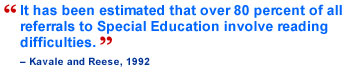
The number of special education students in the U.S. has
almost doubled over the past twenty-five years. These students
now represent a substantial and rising percentage of the total
population in U.S. schools. Of the six million students enrolled
in special education programs, half have been identified as
having a specific learning disability, which the Federal Individuals
with Disabilities Education Act (IDEA) defines as:
A
disorder in one or more of the basic psychological processes
involved in understanding or in using language, spoken or
written, that may manifest itself in an imperfect ability
to listen, think, speak, read, write, spell, or to do mathematical
calculations, including conditions such as perceptual disabilities,
brain injury, minimal brain dysfunction, dyslexia, and developmental
aphasia. (The President 's Commission on Excellence in
Special Education, 2002,and Teaching LD.org,2002)
Statistics show that many of these students fail to reach
the academic achievements of their peers. In an effort to
investigate opportunities to improve the performance of special
education students nationwide, President George Bush created
The President's Commission on Excellence in Special Education
in 2001. After months of public hearings and evidence gathering,
the Commission released its findings and recommendations in
a report entitled "A New Era: Revitalizing Special Education
for Children and Their Families." The findings are sobering.
The report states that students with disabilities are twice
as likely to drop out of school as their peers. Even more
troubling is the Commission's conclusion concerning why the
majority of students with specific learning disabilities are
placed into special education programs
"�simply because they have not learned to read.
Thus, many children identified for special education —
up to 40% — are there because they were not taught to
read. The reading difficulties may not be their only area
of difficulty, but it's the area that resulted in special
education placement. Sadly, few children placed in special
education close the achievement gap to a point where they
can read and learn like their peers.(The President's Commission
on Excellence in Special Education,2002)
Thus, a staggering 2.4 million students are enrolled into
special education programs because of an inability to read.
Clearly, many children are not responding to the reading instruction
they are receiving, whether in the general education classroom
or the special education classroom.
In its major recommendations, the Commission set three overarching
goals:
- "Focus on results — not on process." Thus,
schools need to concentrate on results and not be consumed
by process and procedures.
- "Embrace a model of prevention, not a model of failure."
In other words, implementing changes to identify and prevent
learning disabilities, rather than dealing with students
once they have failed, should be the primary objective.
- "Consider children with disabilities as general education
children first." Thus, general education and special
education should not be treated as separate systems. Instead,
general education and special education should share the
responsibilities in areas of cost, instruction, and identification.
(The President's Commission on Excellence in Special Education,
2002)
The Commission's recommendations, particularly in the areas
of accountability and results, were also affirmed in the 2002
Elementary and Secondary Education Act (ESEA), also known
as the No Child Left Behind Act (NCLB). Going forward, educational
standards and school accountability systems must also apply
to students with disabilities (National Association of State
Directors of Special Education, 2002).
As a result of the above policy changes and other federal
legislation, many schools have adopted the practice of inclusion,
in which students with disabilities participate in general
education classrooms. Consequently, many teachers now need
to provide appropriate instruction for an even wider range
of student needs. The current environment of decreasing funds
has made this task especially difficult. In order to meet
these demands, districts are seeking innovative, cost-effective,
and proven programs that meet the needs of all students.
With a growing population of struggling readers in special
education programs, the need for an effective and research-based
solution is critical. READ
180 meets the needs of Special Needs students and
offers them the potential to succeed. After over a dozen years
of academic and classroom research, READ 180 is producing
quantifiable improvements in reading achievement among struggling
readers in special education programs across the country.
School Studies
The following school success studies demonstrate the effectiveness
of structured reading intervention on student reading achievement
in special education programs.
|






